In this week’s post, guest Jeff Bailey explores why trying to calm the nervous system directly often backfires. He challenges the idea that relaxation can be forced and explains how reorganizing the body’s structure can reduce underlying stress signals, allowing calm, clearer thinking, and a more regulated state to emerge naturally.
march 12, 2026
We can describe our feelings. We can name sensations. We can say, “I feel anxious,” or “I feel calm.”
But we can’t actually experience the nervous system itself.
It works behind the scenes. And yet so much of modern wellness culture is focused on calming it.
The vagus nerve has become a popular topic. Because of its central role in the parasympathetic nervous system, countless therapies now aim to stimulate it — breathwork techniques, cold exposure, humming, supplements, and devices. Many are well-intentioned. Many even work.
Temporarily.
But here’s a deeper question:
Would you rather calm your nervous system… or get to the root of the anxiety and undo it? Forever.
The Paradox of Trying to Relax
Ironically, trying to relax can increase tension.
It’s nearly impossible to directly target the nervous system and command it to calm down. Yet that’s what many of us attempt. We want relief without reorganization. We want calmness while maintaining the same habits, pressures, and structural patterns that generate stress in the first place.
So we stimulate calmness:
Breathing exercises
Meditation apps
Aromatherapy
Intense workouts
Even medication
These can help. But if the underlying signals of stress remain, the calm fades.
In Avita Yoga, we don’t try to pacify the mind. We remove what agitates it.
The Back Door Approach
If you can’t directly access the nervous system, how do you influence it?
Through structure.
The bones are the deepest physical layer of the body. Around every joint are millions of proprioceptors embedded in fascia. These receptors constantly send feedback to the brain about position, pressure, balance, and safety.
When joints are compressed unevenly, become unstable, or are restricted, the nervous system interprets this as a threat. It braces. Muscles tighten. Breathing changes. Thought patterns follow.
When joints are organized and stable, the nervous system interprets safety.
Calm is not something we manufacture. It is something that emerges when threat signals decrease.
This is what we call working through the “back door.” Instead of telling the nervous system to calm down, we reorganize the structural environment it is monitoring.
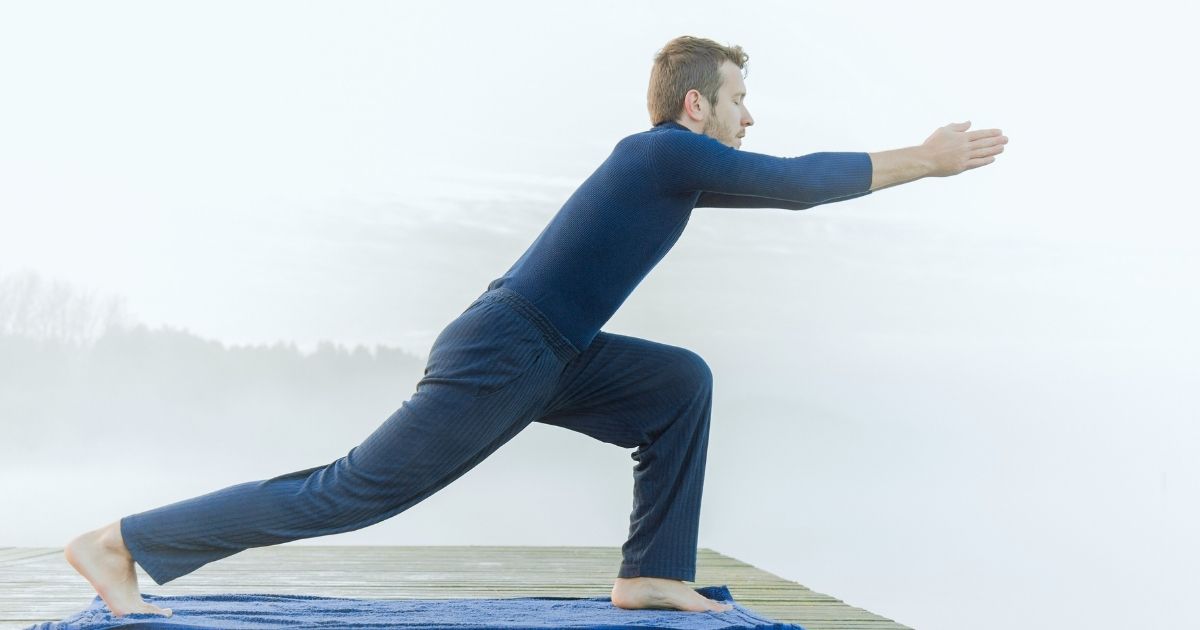
We use slow, deliberate shapes that apply steady, tolerable pressure to the joints. We don’t force range of motion. We don’t chase “the edge.” We bring attention to places that feel restricted or overworked, which allows the body to reorganize.
We hang out in what I refer to as healing sensation. We observe. We wait and watch from the inside, with our eyes closed.
As joint forces redistribute and gravitational lines realign, the nervous system recalibrates on its own.
It’s subtle. But it’s durable.
Practical Entry Points
If this sounds abstract, consider something simple.
Notice how you feel when you slump forward for long periods — shoulders rounded, head forward, weight collapsed into your hips. Breathing is imparted. Muscles brace. The mind often follows.
Now compare that to standing upright with your weight evenly distributed through your feet, your spine long, and your ribs balanced over your pelvis. Even without trying to relax, the bio-mechanics of breath. Thoughts lighten.
The structure changed first. The nervous system followed.
Or consider a different example: when you gently compress your hands together for thirty seconds — not forcefully, just steadily — and then release. There’s often a feeling of warmth, clarity, and even ease. That sensation isn’t just muscular. It’s neurological.
The body and brain are in constant dialogue.
Instead of layering new skills on top of old patterns, what if we gently unwound the limiting patterns themselves?
Some try to “improve” their nervous systems by adding stimulation—puzzles, new languages, high-intensity workouts, and competitive sports.
But clarity often comes not from adding complexity, but from removing distortion.
Isn’t this the aim of meditation?
Peace. Clarity. Less interference.
Avita Yoga becomes a kind of moving meditation — not because we try to empty the mind, but because we reduce the structural conflict that agitates it.
Reorganizing for Calm
Have you ever considered that anxiety might not be something to suppress, but something to reorganize?
Structural instability and uneven forces generate constant low-level signals of vigilance. The nervous system compensates by tightening, guarding, and scanning for danger.
When movement becomes organized and joints articulate intelligently, bracing diminishes.
When bracing diminishes, breath softens. When breath softens, perception changes. When perception changes, the peaceful mind emerges.
Calm is not induced.
It is revealed.
We often assume anxiety is the baseline, and calm must be achieved. But what if calm is the baseline — and stress is the accumulation of structural and neurological noise?
Instead of asking, “How do I calm down?” We might ask, “What wants to come up as I reorganize myself?”
It’s how we remove the obstacles to peace and mobility.
Because sometimes the most direct path to a relaxed mind is an organized body.
By Jeff Bailey
Jeff Bailey has taught over 13,000 classes and workshops and founded Avita Yoga, bringing a revolutionary approach to health. He has helped thousands overcome pain and return to their favorite activities and has authored two books: The Yoga Mind and his national bestseller, Mobility For Life. https://avitayogaonline.com